
First-visit guide · checked July 2026
Souk El Had Agadir
When to go, what to buy, how to bargain and how not to get lost in Agadir's vast walled market.
The short answer
Is Souk El Had worth visiting?
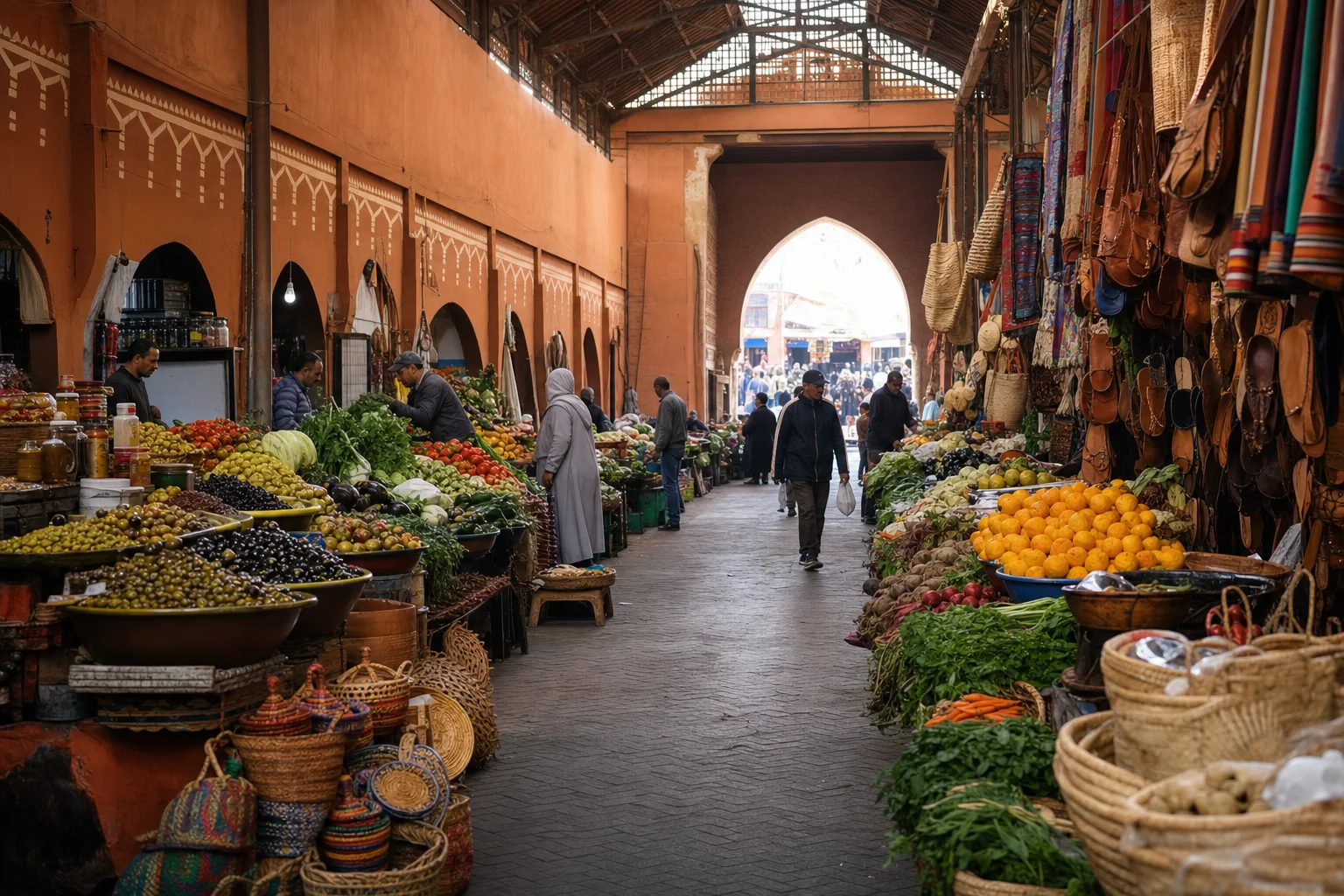
Yes—go early on a Tuesday-to-Sunday morning and allow 90 minutes to three hours. Souk El Had is not a small souvenir market: the official regional tourism guide describes more than 13 hectares, over 3,000 shops and 13 entrances. The central produce areas, spices, local foods, crafts and everyday household trade make it useful even if you buy nothing.
Most important detail: it is closed on Mondays for weekly cleaning. Current listings commonly show roughly 9:00 am–8:00 pm on open days, but holiday, Ramadan and Friday routines can shift. Confirm the day before travelling.
Plan before entering
Souk El Had opening days, best time and practical cost
The market is free to enter. Your real decisions are when to go, which gate to remember and how long to stay.
| Question | Practical answer | What to verify |
|---|---|---|
| Open days | Tuesday–Sunday | Holiday and Ramadan changes |
| Monday | Closed for weekly cleaning | Do not plan a Monday visit |
| Best arrival | Early weekday morning | Your chosen entrance gate |
| Focused visit | About 90 minutes | Two or three shopping categories |
| Slow visit | Two to three hours | Food stop and group meeting point |
| Admission | Free | Cash for shopping, snacks and taxi |
Early beats late
Mornings are cooler and easier for comparing. Weekend and late-afternoon trade can feel more intense, especially when your objective is crafts rather than groceries.
Save your entrance
Take a photo of the gate number or drop a map pin. With 13 doorways, “meet outside” is not precise enough if a family or group separates.
Use a petit taxi
From Agadir Beach, a city petit taxi is usually simplest. Show the destination, confirm the meter or quoted arrangement and specify the return gate or landmark.
Choose comfort
Wear secure shoes and a light layer you can manage in covered and open sections. Keep valuables zipped and carry only the cash you expect to use.
Shop with a purpose
What to buy—and what to compare—at Souk El Had
The official tourism guide lists fresh goods, crafts, clothing, technology, household products, spices, books, amlou, honey, oils and cosmetics. Pick a few categories rather than trying to inspect everything.
Produce, olives and spices
The fruit-and-vegetable area is part of the market's everyday life. For spices, compare aroma, colour, turnover and price; do not assume the most dramatic display is the best quality.
Amlou, honey and edible oils
Ask about ingredients and origin, inspect the container and buy an amount you can transport safely. “Natural” and “organic” are claims to verify, not guarantees created by the setting.
Leather, baskets and woodwork
Check stitching, symmetry, smell, lining, handles and finishing. Compare at least two stalls before buying and ask whether a large item can be packed for travel.
Textiles and clothing
Inspect fibres, seams, colour transfer and sizing. A Moroccan-style garment is not automatically locally handmade; ask who made it and decide based on the object, not the sales story.
Cosmetics and argan products
Look for a sealed, labelled product with ingredients and a sensible use-by date when possible. Culinary and cosmetic argan oils are different; ask which one you are buying.
Everyday household goods
Kitchenware, tools, toys, electronics and daily-use products show why locals shop here. These sections are often more revealing than the stalls designed primarily for visitors.
Pay fairly and calmly
How to bargain at Souk El Had without turning it into a battle
Greet first
A simple “salam” and a respectful question start better than demanding the lowest price. Ask before photographing people or a stall at close range.
Compare before offering
Look at several examples of the same category. You need a real reference for quality and price before deciding whether negotiation is appropriate.
Make one serious offer
Choose a number you would genuinely pay, respond calmly and avoid theatrical “final price” routines. Food with posted prices may not be negotiable.
Be willing to leave
If you do not agree, thank the seller and walk away. Do not negotiate an item down and then refuse it for sport; bargaining should lead toward a possible sale.
Cash: carry Moroccan dirhams in smaller notes. Count change before leaving, keep your wallet out of view between purchases and do not rely on every stall accepting cards.
A simple first visit
A 90-minute route through Souk El Had
This is a decision route, not a fixed gate map. Market sections and stall positions can change.
- Photograph the entrance
Record the gate and agree on a meeting point before anyone starts browsing.
- Walk to produce and olives
Use the food areas to understand the market before focusing on souvenirs.
- Choose two craft categories
For example, compare baskets and leather rather than trying to price every product type.
- Buy local foods last
Amlou, honey or spices are easier to carry when you are close to leaving.
- Stop for m'semen or juice
Pick a busy, clean-looking counter and ask the price before ordering.
- Return to the saved gate
Check purchases and change before finding a taxi or continuing the day.
Avoid the common errors
Six Souk El Had mistakes that waste time or money
Turning up Monday
The weekly closure is the easiest mistake to prevent. Use Monday for a museum, Medina Polizzi or the beach instead.
Trying to see every aisle
The market is too large for exhaustive browsing. Pick categories, a time limit and an exit gate.
Buying at the first stall
Comparison is part of the value. Inspect differences in workmanship, freshness, packaging and price.
Believing every origin claim
Ask questions, but judge the product in front of you. A confident story is not proof that an item is handmade, antique, organic or locally produced.
Forgetting small cash
Large notes slow simple purchases and may be difficult to change. Separate a modest shopping amount from your main wallet.
Losing the group
Mobile signal and messages are not a substitute for a physical meeting point. Save the gate before entering.
Direct answers
Frequently asked questions about Souk El Had Agadir
Is Souk El Had open on Mondays?
No. The official regional tourism guide says Souk El Had closes on Mondays for weekly cleaning. Plan the visit from Tuesday to Sunday and recheck holiday or Ramadan changes before travelling.
What are the opening hours of Souk El Had Agadir?
Current market listings commonly show Tuesday to Sunday from about 9:00 am to 8:00 pm, but the official regional guide confirms only the Monday closure. Hours can shift for Ramadan, Eid and local circumstances, so verify on the day.
What is the best time to visit Souk El Had?
Go early on a weekday, ideally soon after opening. The official regional tourism guide also recommends an early weekday visit. It is cooler, calmer and easier to compare stalls than late afternoon or the weekend.
How long do I need at Souk El Had?
Allow about 90 minutes for a focused first visit or two to three hours if you want to compare crafts, buy produce, stop for food and explore without rushing. Agree on a meeting gate if your group splits up.
What should I buy at Souk El Had?
Popular categories include spices, olives, fruit, vegetables, amlou, honey, oils, leather goods, baskets, textiles, clothing and household goods. Compare quality and price across several stalls, especially for cosmetics and edible oils.
Do I need cash at Souk El Had?
Yes. The official regional tourism guide advises carrying cash because many shops do not accept cards. Bring smaller Moroccan-dirham notes, keep money discreet and ask the full price before committing.
Should I bargain at Souk El Had?
Bargaining can be appropriate for crafts, clothing and discretionary goods, but not every food or produce price is negotiable. Compare first, negotiate politely and walk away calmly if the price does not suit you.
How do I get to Souk El Had from Agadir Beach?
A petit taxi is usually the simplest option from the beach district. Show the driver Souk El Had, agree on the metered or quoted arrangement before departure, and choose a gate or nearby landmark for pickup because the market has 13 entrances.
Is Souk El Had worth visiting if I do not want to shop?
Yes. The produce halls, spice stalls, food counters and scale of the walled market make it a useful introduction to everyday Agadir. A focused walk and snack can be worthwhile even without buying souvenirs.
Sources and limits
How this guide was checked
Size, Monday closure, access, product categories, cash advice and the early-weekday recommendation come from the official Souss-Massa regional tourism site. Current-hour listings and recent visitor questions were checked separately because operating details can change.
Reddit use: r/Agadir and r/Morocco discussions informed questions about taxis, Friday pauses, clothing, food products and trip length. Anonymous comments were not treated as verified facts or endorsements.
Sources checked on 18 July 2026
Found a changed opening day, access rule or major layout detail? Contact +212 6 62 57 57 11 so the editorial team can verify and correct it.